HOUSTON’S FAMOUS TREES - EARTH MONTH SPECIAL
Houston’s Living Landmarks: A Look at the City’s Tree Heritage and Culture
By The Heritage Society • Credit: Barry Ward, Executive Director, Trees for Houston
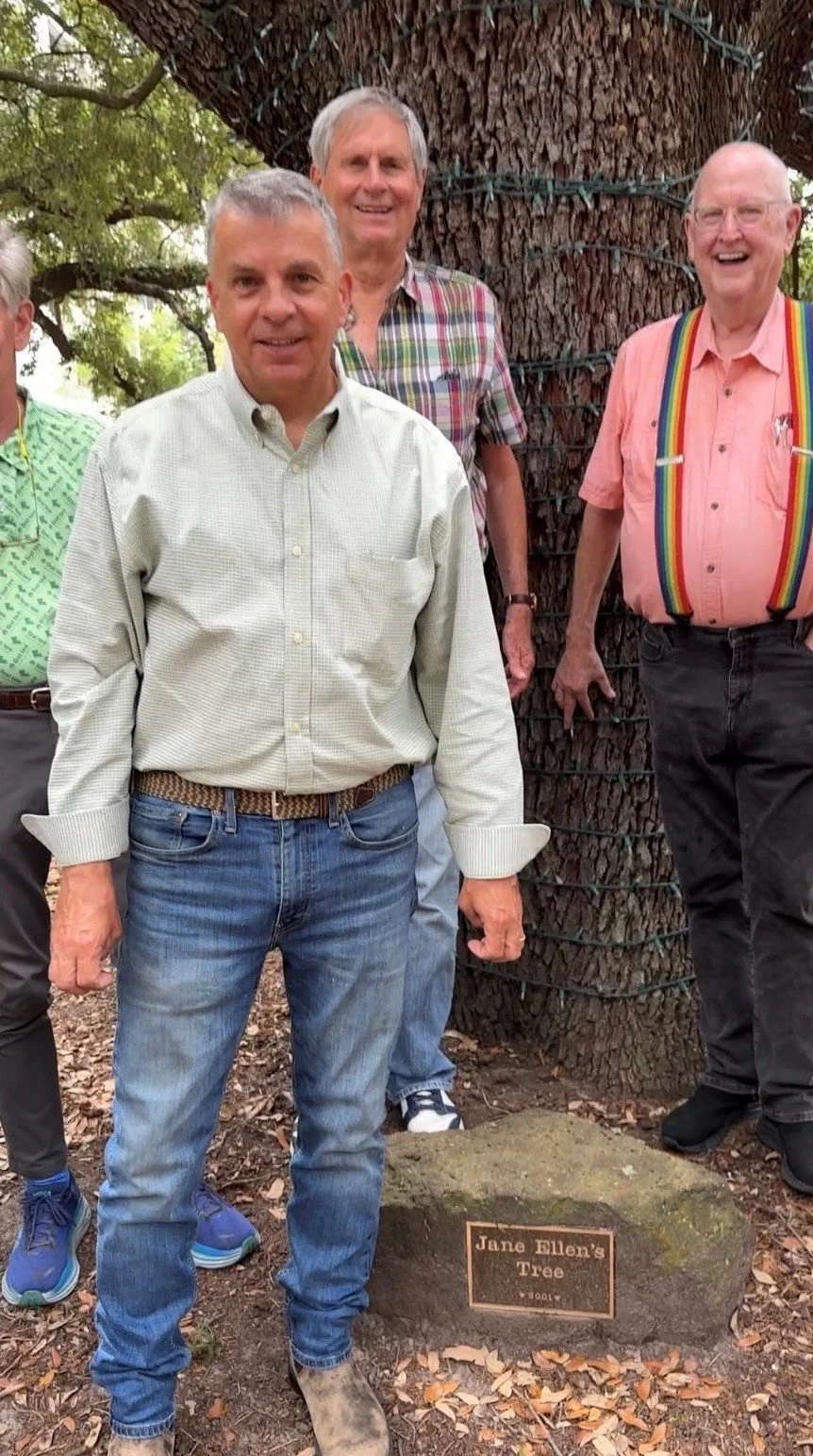
Barry Ward shared a funny memory about the late executive director, jane ellen. she brought her dog to work, and the dog went into his backback and ate his lunch. the tree in our plaza was named after her. she was also the first female executive director of the heritage society.
April 22, 2026 — In a city better known for freeways, bayous and breakneck development, Houston’s trees stand as some of its most enduring landmarks. They shade historic homes, anchor neighborhoods, and tell stories that stretch back centuries — long before the city itself was founded.
Houston’s tree culture is shaped not only by its climate and clay-heavy soil, but by a long tradition of civic stewardship. Few people understand that better than Barry Ward, Executive Director of Trees for Houston, who has spent nearly two decades expanding the region’s urban forest.
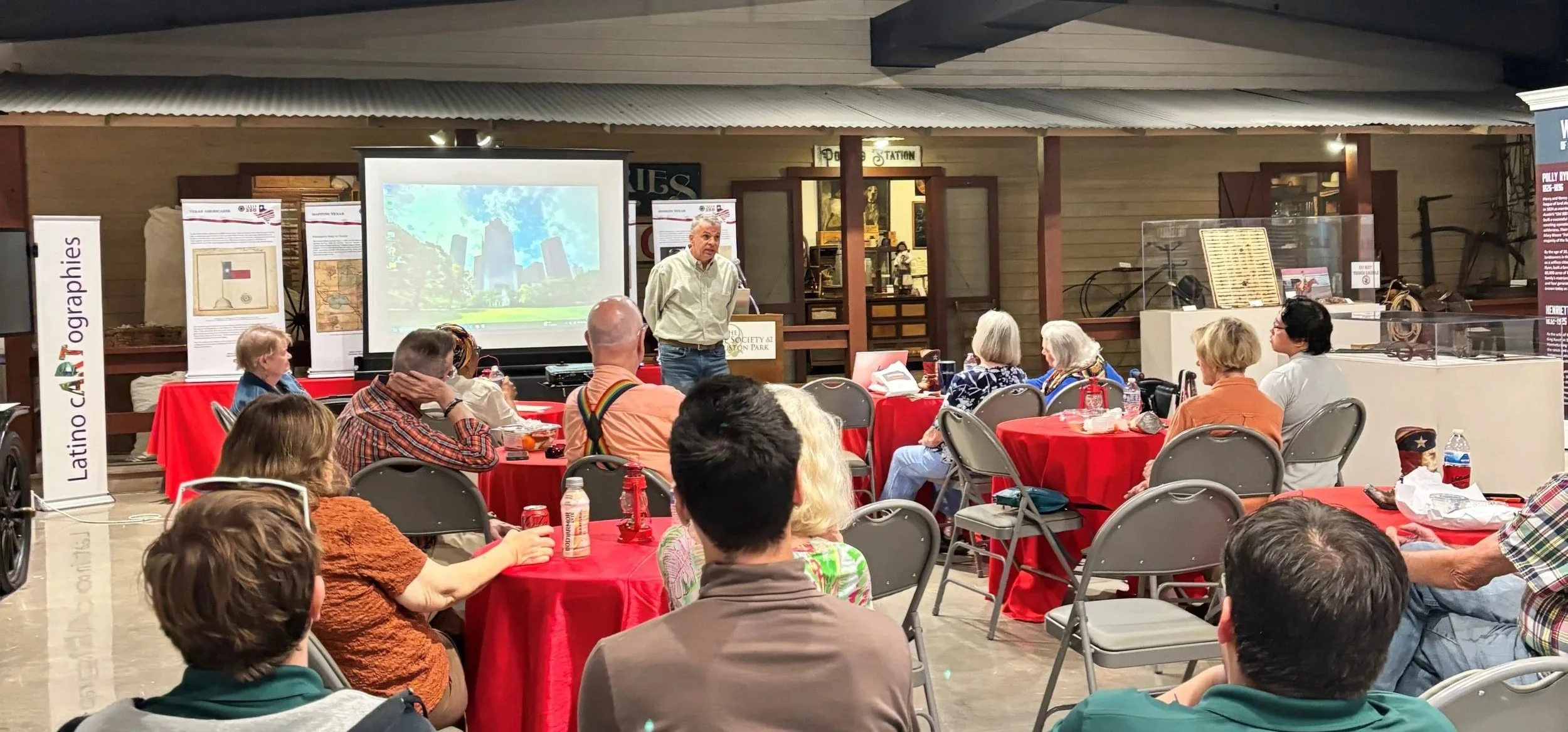
Ward delivered these insights as the featured speaker for The Heritage Society’s Lunch & Learn celebrating Earth Month on April 16, 2026, where he discussed Houston’s tree culture, urban forestry, and the city’s evolving landscape. The program, held at Sam Houston Park, drew a full audience eager to learn about the region’s environmental history and the work of Trees for Houston. The transcript of his remarks comes from this event, where Ward blended science, history, and humor to illuminate the vital role trees play in Houston’s past and future.
“We’re kind of an ombudsman for trees,” Ward told the audience. “We are not policy people… We just get the funding and then we get the trees in the ground.”
A City of Survivors: Houston’s Oldest Trees
Some of Houston’s most famous trees predate statehood. The region’s oldest live oaks — many between 300 and 500 years old — survived settlement, storms, and the city’s explosive growth.
At Sam Houston Park, several sprawling live oaks are believed to be more than two centuries old. These trees, Ward explained, are not recent plantings but “survivors,” remnants of the landscape that existed long before Houston’s founding in 1836.
Live oaks, he noted, can be deceptively difficult to age. “When you plant a live oak around structure and get irrigation to it, it will grow like a weed for about 15 years,” Ward said. “They don’t do that in nature.” A 50‑year‑old irrigated tree can appear centuries old — but the true elders are found in parks, prairies, and historic homesteads where they grew without human intervention.
One of Sam Houston Park’s most beloved landmarks is Jane Ellen’s Tree, a sprawling live oak whose massive, ground‑reaching limbs have long captured the imagination of visitors. Though its exact age is unknown, arborists estimate it may be 250 to 300 years old, placing its earliest growth well before Houston’s founding. As Ward explained, aging a live oak with precision is notoriously difficult. “Aging them is quite problematic, unless you core it,” he said, noting that the only truly accurate method would require invasive techniques that could harm or even kill the tree. For now, Jane Ellen’s Tree remains a living mystery — and one of the park’s most enduring natural treasures.
One of the region’s most storied specimens is the Compton Oak in League City, which Ward’s team once helped relocate — a massive undertaking requiring specialized equipment and extraordinary funding. Another is the centuries‑old live oak at Beck’s Prime on Augusta, estimated at 400–500 years old.
“Go to Beck’s Prime and tell the 500‑year‑old live oak how it got here,” Ward joked, pushing back on the myth that live oaks are not native to Houston.
Tree Culture in a Changing City
Houston’s relationship with trees has shifted dramatically over time. Early neighborhoods — built before widespread air conditioning — were designed with wide planting verges and generous shade canopies. Later development patterns narrowed planting strips, reduced green space, and increased impervious cover.
Ward notes that Houston likely has more trees today than it did 200 years ago, but fewer than it had 40 years ago, due to rapid development and the loss of older canopy.
The city’s clay soil also shapes its tree culture. Most native species develop shallow root systems — typically 18 to 24 inches deep — because the dense clay and high water table make deep taproots unnecessary. This makes trees both resilient and vulnerable: they can survive droughts and storms, but they struggle when squeezed into narrow planting strips or placed under power lines.
Ward is candid about the challenges of urban forestry. “My only job, my purpose in life, is to have more trees, not less,” he said. But he also emphasizes practicality: moving a mature tree can cost hundreds of thousands of dollars, while planting a younger tree is far more sustainable.
“The big tree is spending all of its energy putting out a root zone to support this big tree,” he said. “If you plant a tree that’s six feet and a tree that’s 20 feet… in five years, you cannot tell the difference.”
Trees for Houston: A Modern Legacy
Founded in 1983 from a coalition of grassroots groups, Trees for Houston has grown into one of the largest regional tree‑planting nonprofits in North America. Under Ward’s leadership, the organization now plants or distributes 70,000 to 100,000 trees each year.
The group focuses on schools, parks, esplanades, and underserved neighborhoods — areas where shade is both a comfort and a public health necessity. “If you’ve lived in Houston for one summer,” Ward said, “you know you don’t want to live or recreate or take a walk where there’s no shade.”
Trees for Houston also distributes tens of thousands of free trees annually, empowering residents to plant on private property — a crucial strategy in a city where much of the land is not publicly owned.
Roots of Faith: The Brushed Arbor and Houston’s Earliest Worship
Ward opened his lecture by noting that “trees served as shelters” in Houston’s earliest years — a remark that naturally led to one of the city’s most significant intersections of nature and history. Along the banks of Buffalo Bayou, early Black Houstonians gathered beneath a brushed arbor, a simple structure of wooden poles and leafy branches that offered shade and sanctuary. It was under one of these arbors that worshippers organized what would become Antioch Missionary Baptist Church, the city’s oldest Black Baptist congregation. The church later moved to Clay Street, where it remains a cornerstone of Houston’s African American heritage.
The moment resonated deeply with the audience because Martha Whiting‑Goddard, a Heritage Society board member and great‑granddaughter of Reverend John Henry “Jack” Yates, was in attendance. Yates, whose 1870 home is preserved in Sam Houston Park, served as one of Antioch’s most influential early pastors. Ward’s reflection on trees as early shelters brought Whiting‑Goddard’s family history directly into the conversation, underscoring how Houston’s natural and cultural roots are intertwined.
A Full‑Circle Moment at The Heritage Society
Ward’s connection to The Heritage Society is personal as well as professional. One of his first curatorial jobs in Houston was at The Heritage Society at Sam Houston Park, long before he entered the world of urban forestry. Decades later, that early chapter came full circle when Trees for Houston selected the park as the site of its one‑millionth tree, planting a large, spaded live oak beside the historic Kellum‑Noble House on February 5, 2026. “We estimated last year we were going to hit our millionth tree,” Ward said. “So, we approached The Heritage Society… We brought a giant spaded tree out and planted it out there in February.” The milestone symbolized both the organization’s growth and Houston’s deepening commitment to its urban forest.
Houston’s Tree Heritage: More Than a Landscape
Houston’s trees are more than greenery — they are cultural touchstones. They mark historic sites, anchor neighborhoods, and connect the city to its ecological past.
From the ancient live oaks of Sam Houston Park to the millionth tree planted by Trees for Houston in 2026, the city’s canopy reflects both its history and its hopes for the future.
As Ward put it, “Every tree planted is an investment in Houston’s future.”